Gas grill won't ignite? Try these 6 fixes first.
Most no-light grills are fixed in minutes with no parts and no money. Work down this ladder in order, free fixes first, and only buy a part if you reach the bottom.
Our safety claims cite primary sources (CPSC, AMA). Picks are cross-checked against the 2026 CPSC wire-bristle recall. Live prices and ratings stay on Amazon, where they’re always current.
If you smell gas, do not try to light the grill and do not flip any electrical switch. Turn off the propane tank valve, step away, and call your gas supplier. A leak is not a DIY fix.
Know the symptom? Jump to it
Most gas grills that won't light are back in service the same afternoon, usually with no parts at all.
- Time
- 15 minutes
- Cost
- Often free
- Skill
- Beginner-friendly
- Tools
- A fresh battery, maybe a brush
- 1 Check gas supply
- 2 Reset the regulator
- 3 Swap the battery
- 4 Clean the electrode
- 5 Clear the burner ports
- 6 Replace parts only if needed
First: is it clicking, or dead silent?
What you hear tells you where to start. Match your symptom and skip ahead.
Heads up: The product links on this site are affiliate links. If you buy through them, Grill Patrol may earn a small commission at no extra cost to you. We only point to gear we’d put on our own grill. Disclosure.
The fix ladder (free fixes first)
Work these in order. The first four cost nothing. Only reach for a part if you've cleared every rung above it.
Check the propane supply
No gas smell at all? Start here.
Deep dive
Shake the tank. A full 20 lb tank feels heavy; an empty one almost weightless. Check the gauge if you have one, and make sure the regulator knob is fully open (counterclockwise).
Refill or swap an empty tank. If the tank has gas but nothing flows, the regulator's safety bypass is the likely culprit. That's the next rung.
Reset the regulator's safety bypass
Tank has gas but the flame is weak, lazy, or won't light.
Deep dive
A common cause after a tank swap is the regulator's safety bypass. Most consumer propane cylinders made since the early 2000s have an Overfill Prevention Device (OPD). If you open the tank valve too fast, the regulator limits gas flow to a trickle as a safety response.
- Turn all burner knobs off.
- Close the tank valve fully (clockwise).
- Disconnect the regulator from the tank.
- Open the grill lid.
- Wait 30 seconds.
- Reconnect and hand-tighten.
- Open the tank valve slowly, about one full turn over 3 to 4 seconds.
- Wait another 30 seconds before lighting.
This resolves it in most cases. When you relight, judge the recovery by heat, not by eyeballing the flame: a grate-level thermometer gives you the real number, and factory lid dials often read low. If flow is still weak after the reset, the regulator itself may be failing. See the parts section.
Check the igniter battery
No click at all? A dead or reversed battery is the usual reason.
Deep dive
Find the battery compartment, usually on the side or front of the control panel. It takes one AA or AAA (varies by model). Pull the battery and check the terminals for corrosion (white or green crust), and confirm polarity: the flat negative end sits against the spring.
Install a fresh battery with correct polarity. If the contacts are corroded, scrub them with a pencil eraser first. A dead battery is one of the most common reasons an igniter won't spark.
- Two-minute fix
Fresh AA / AAA batteries
If the igniter clicks but nothing sparks, or it's dead silent, a dead battery is the most common cause. Grab the size your igniter takes (check the compartment), install it with the flat end against the spring, and try again.
No battery compartment anywhere? You have a piezo igniter, a spring-loaded striker with no battery to swap. Skip to the electrode check.
Clean the electrode and check the gap
Clicks but no spark, or a weak spark that won't catch.
Deep dive
With the gas off and the tank valve closed, find the electrode. It is a small ceramic-and-metal probe just above or beside the burner. Look at the metal tip: grease, carbon, or rust will kill the spark, and a cracked ceramic collar will bleed it to ground.
Wipe the tip with a dry cloth, or a cotton swab with a little rubbing alcohol for baked-on grease, then let it dry fully before testing.
If your model uses a metal collector box behind the tip, the spark gap is typically small (often around 1/8 to 1/4 inch). Check your model's spec before adjusting. Make only small adjustments with the gas off: forcing the electrode can crack the ceramic.
A cracked ceramic collar or a tip that won't come clean means a replacement electrode, and electrodes are model-specific. Weber Spirit owners can skip the guesswork in our Weber Spirit parts guide; every other grill, match the part to your brand and model before ordering.
Clear the burner ports
Sparks fine, smells gas, still no light? Look for a spider web.
Deep dive
Insects, mud daubers and spiders especially, nest inside burner tubes between cooks. Even a partial blockage stops gas from reaching the spark. With the gas off, pull the grates and heat tents and shine a flashlight through the burner ports; you should see light through the small holes.
The match test settles it: turn on one burner and hold a long lighter to the ports. If it lights with a match but not the igniter, your gas and burner are fine. The problem is the igniter system, not the gas path.
To clear a clog, turn the gas fully off and run a thin wire brush or stiff pipe cleaner through the ports and tube opening. Do not use water; it drives debris in. Do not use a toothpick that can snap off inside. Our burner tube cleaning guide walks the full job, including how to tell a clog from a tube that is rusted through.
- Unlocks a free fix
Venturi / burner-tube cleaning brush
A spider web or debris plug inside the burner tube blocks gas from reaching the spark. It's the most common non-obvious ignition failure. A long, thin brush clears it in a minute. No parts, no money beyond the brush.
-
 For the teardown
Heat-resistant grill gloves
Reaching the electrode and burner ports means pulling grates and heat tents out of a greasy firebox. These are rated to 932°F, so you can lift warm parts and keep rust and grease off your hands while you work the fix ladder.
Light it with a match as a backup
A workaround to keep cooking while you source parts. Not a permanent fix.
Deep dive
If the igniter is down, you can still cook safely. Open the lid fully first. Hold a lit long-handled lighter or match at the burner port, then turn on the gas. Never gas first, then flame. If it doesn't light in a few seconds, turn the gas off, wait at least a minute for it to clear, and try again. Never lean over the grill when lighting.
Most burner clogs and fouled electrodes are a cleaning problem. A regular brush-down keeps gas flowing and the spark clean. We tested a bunch and found a brush that won't leave wire bristles in your food. Here's the one we trust.
Still no spark? Replace the parts
You've confirmed the battery is fresh, the electrode is clean and intact, and gas is reaching the burner, but still nothing. Now it's worth replacing parts. Try the cheaper electrode first; replace the whole kit if that doesn't do it. And if the spark is strong and gas flows but a burner still won't light, the tube itself may be rusted through. Igniters aren't universal, so match any part to your grill's brand and burner count before ordering.
The parts cards below are affiliate links. If you buy through one, Grill Patrol earns a small commission at no extra cost to you.
-
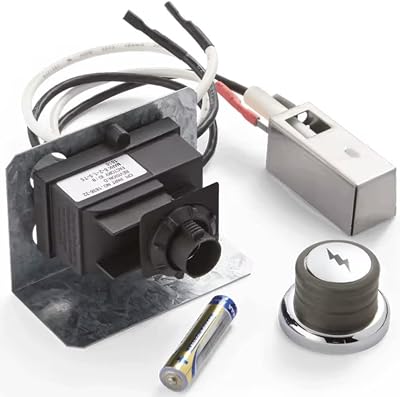 Exact fit: Spirit 2009-2012
Weber igniter kit (Spirit 2009-2012)
Own a Weber Spirit from the 2009-2012 generation? This genuine Weber kit is an exact fit for that model run and gets you back to a one-click light, with no universal guesswork.
-
 Replacement part — not a cleaner
Stainless replacement burner tube (fits front-control Weber Spirit E/S-210)
Cleaned the ports and the burner still won't light or the flame stays weak? The tube has likely rusted through, and gas is escaping before it reaches the ports. This stainless replacement fits the front-control Weber Spirit E-210 or S-210; confirm your grill is that model run before ordering. Every other grill: match the tube to your brand and model.
Not a Weber Spirit owner? Match the part to your grill
-
Replacement electrode + wire
If the button clicks but the electrode is cracked or corroded, you often don't need the whole kit. Just swap the spark tip and its wire. Electrode shape and the wire boot vary by model, so match it to your grill before ordering.
-
Replacement igniter kit (match your model)
If the module produces no click, or a click with no spark anywhere, the igniter assembly itself has failed. Kits bundle the module, electrode, and wire so you fix every failure point at once. Igniters are not one-size-fits-all: match the kit to your grill's brand and burner count before you order.
Igniter modules and electrodes are model-specific. The kit above fits the 2009-2012 Spirit generation exactly. For newer front-control Spirits, and every wear part on them (igniters, burners, grates, Flavorizer bars), see our Weber Spirit 300 parts guide.
Not sure which Spirit you have? Our Spirit 200 vs 300 parts guide sorts it out.
Replace the part, or the grill?
If the igniter is the only problem, parts are inexpensive and the fix is quick. But if your grill also has rusted grates, a corroded burner, or a rusted-through firebox, you're past an igniter fix. Our full grill restore guide walks you through bringing it back to life, or knowing when to let it go.
FAQ
The igniter is sparking, but the spark isn't meeting gas where it needs to. The usual causes, in order: the regulator's safety bypass is limiting gas after a tank swap; a spider web or debris is blocking the burner ports; the electrode tip is fouled with grease or its gap is off; or the spark is grounding out before it can ignite. Work the supply, ports, and electrode steps above in that order.
Start with the battery. A dead or reversed battery is the most common cause of complete silence. If a fresh, correctly-installed battery doesn't bring the click back, check the igniter wire for damage or a short against the grill body. If the wire is fine, the module itself has likely failed and the kit replaces it.
Good news: your gas supply and burner are fine. The problem is entirely in the igniter system. Focus on the electrode tip, the spark gap, the igniter wire, and finally the module. Each is covered above, cheapest fix first.
A fresh battery rules out the most common cause but not all of them. Next, clean the battery contacts (a pencil eraser works), confirm polarity, then check the igniter wire for damage or contact with the grill body, inspect the electrode for cracks or heavy fouling, and confirm the spark gap is right. If all of that checks out, the module has failed and needs replacing.
Weak, lazy, or yellow flame on all burners after a tank swap usually points to the regulator's safety bypass. Run the full reset above. If it's still weak afterward, the regulator may be failing. Weak flame on just one burner more often means a clogged port on that burner.
Yes, with care, and treat it as a temporary workaround rather than a fix. Open the lid fully first. Hold the lit match or a long lighter at the burner port, then turn on the gas. Never gas first. If the burner doesn't catch within a few seconds, shut the gas off, wait at least a minute for it to clear, and try again. Never lean over the grill while lighting.
Storage is hard on grills. The regulator's safety bypass often trips when you reconnect the tank, insects nest in the burner tubes over winter, and battery contacts corrode. Run the regulator reset first, then check the battery and look through the burner ports before assuming a part has failed.
The clean routine that prevents most ignition problems
Blocked ports and fouled electrodes are cleaning problems. Print the routine and keep it at the grill, or have it emailed once email delivery is switched on.
Email is not switched on yet.
We have not turned on email delivery, so your address was not saved. The checklist is ready now and needs no email: open the printable checklist →
You are on the list.
The checklist is headed to your inbox. Every email comes from Grill Patrol (Alliterate Labs) and carries an unsubscribe link in the footer.
That did not go through.
Nothing was sent. The checklist needs no email: open the printable checklist →
The three tools this routine uses
These are affiliate links. Grill Patrol may earn a commission at no extra cost to you. Disclosure.
- Bristle-free grill brush + scraper The step 2 tool. Scrubs warm grates with no wire bristles to end up in food. Check it on Amazon →
- Citrusafe grill cleaner The soak-and-wipe degreaser for the heat tents and the grease tray. Check it on Amazon →
- Maryton Grill Stone Cleaning Brick (3-Pack) Swap for the brush if you prefer scrubbing. Pick one, not both. Check it on Amazon →
Keep the grill in shape
-
Bigger problems than the igniter? Restore the whole grill
Rust, dead burners, flaking grates. The honest weekend restore for a free or hand-me-down grill.
Read it → -
The safest grill brushes (no wire bristles)
Regular cleaning is what keeps ports clear and electrodes sparking. The bristle-free picks we trust.
Read it → -
Weber Spirit 300 parts that wear out
Exact-fit igniter, grates, burners, and Flavorizer bars for a front-control E-310/320/330.
Read it → -
How to deep-clean a gas grill
The full teardown that prevents most no-light problems before they start.
Read it →
Grab the free hand-me-down restore checklist. No email required. Print it or keep it on your phone. Get the free checklist.
Different problem? If your grill lights fine but the flame dies mid-cook, that is a stay-lit issue. Gas grill burner won't stay lit.