The safest grill brushes without wire bristles
A wire grill brush can shed a tiny metal bristle onto the grate, into your food, and into someone’s throat. It’s a real, documented hazard. The safest fix is to skip wire bristles entirely. Here are the bristle-free brushes we trust, and the safety case behind them.
Our bristle-free picks
How we pick: bristle-free only, cross-checked against the 2026 CPSC recall list. We cite primary sources for our safety claims; see the CPSC and AMA links below.
Heads up: The product links on this site are affiliate links. If you buy through them, Grill Patrol may earn a small commission at no extra cost to you. We only point to gear we’d put on our own grill. Disclosure.
-
 Best overall
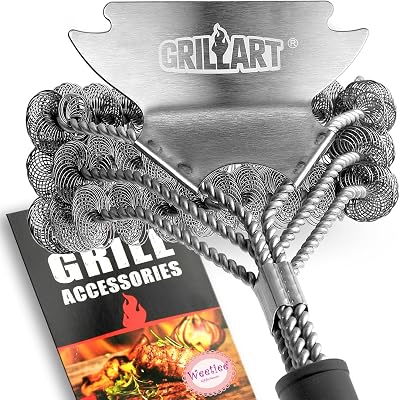
Bristle-free grill brush + scraper
A coiled-wire scraper head: the cleaning surface is one continuous coil, so no single metal bristle can snap off, stick to a grate bar, and end up in food. A built-in scraper edge on the back handles baked-on carbon the coil misses. Preheat the grill about 10 minutes, then scrub with firm strokes. The bristle-free pick in every Grill Patrol kit.
-
 Premium pick
GRILLART bristle-free steam brush
A heavier-duty bristle-free head with a replaceable cleaning pad. Steam-cleans grates without any wire that can break off into your food. Step up if you grill often.
What else we verify
No brand pays us to feature a product here. Every pick has to be a current Amazon listing we re-check for stock and recall status, with a real track record of buyer reviews rather than a brand we have not seen hold up.
Why wire bristles are dangerous
Wire-bristle brushes wear out by shedding. A loose bristle can cling to a hot grate, transfer to food, and be swallowed, where it can lodge in the throat, tonsils, or intestines and require surgery to remove.
- In February 2026 the U.S. CPSC announced a recall of over 3.2 million wire-bristle grill brushes after dozens of bristle-detachment reports and several people who needed medical treatment for swallowed bristles. (CPSC recall)
- The American Medical Association has cautioned that wire bristles “break off and stick to the food being cooked,” and can lead to a surgical emergency. (AMA)
- CDC injury data has documented thousands of emergency-room visits tied to ingested grill-brush bristles over a multi-year span.
Note: the recall and these warnings are about the hazard of wire bristles. Choosing a bristle-free brush is our recommendation for avoiding that hazard, not an official endorsement of any product.
What makes a grill brush safe
- No loose wire. Look for coiled-wire heads (one continuous coil), woven stainless mesh, or a solid scraper. Nothing that can snap off as a single bristle.
- A scraper edge. Handles baked-on carbon the brush face can’t.
- Replaceable or inspectable heads. So you swap the cleaning surface before it wears out.
- A long handle. Keeps your hand off a hot grate while you scrub.
How to clean safely
- Heat the grill for ~10 minutes to loosen residue, then brush while warm (not cold).
- Use a bristle-free brush or scraper; wipe the grate with a damp cloth once cool.
- Inspect the brush head every few cooks and replace it the moment it looks worn.
- Empty the grease tray. A full tray is the number-one grease-fire cause.
A brush keeps a clean grate clean, but if rust has already set in, no brush fixes that. See our guide to removing rust by grate type, and for a heavy cast-iron set, how to strip and re-season the iron.
Time for the full teardown?
How to deep-clean a gas grill: the quarterly teardown that kills flare-ups.
The every-cook routine
The fast, safe way to clean grates after each cook. Built-in routine too.
FAQ
Yes. Coiled-wire, woven-mesh, and scraper-style heads clean baked-on grease and char as well as a traditional brush. They just do it without loose wire bristles that can break off. Cleaning a warm grill (not cold) does most of the work either way.
Individual metal bristles can detach, stick to the grate, and end up in food. Swallowed bristles can lodge in the throat or gut and require surgery. In February 2026 the CPSC and Weber recalled over 3.2 million wire-bristle brushes after dozens of detachment reports and several injuries.
Inspect it every few cooks. Replace any brush (bristle-free included) the moment the head looks bent, frayed, or worn. A damaged brush of any kind is more likely to shed material.
Heat the grill, then use a bristle-free scraper, a balled-up piece of foil held with tongs, or a wooden grate scraper. Follow with a damp cloth once cool. Our cleaning guides walk through the full routine.
The three-tool restore kit is the short list of what actually brings a free grill back to par.
See the restore kit →